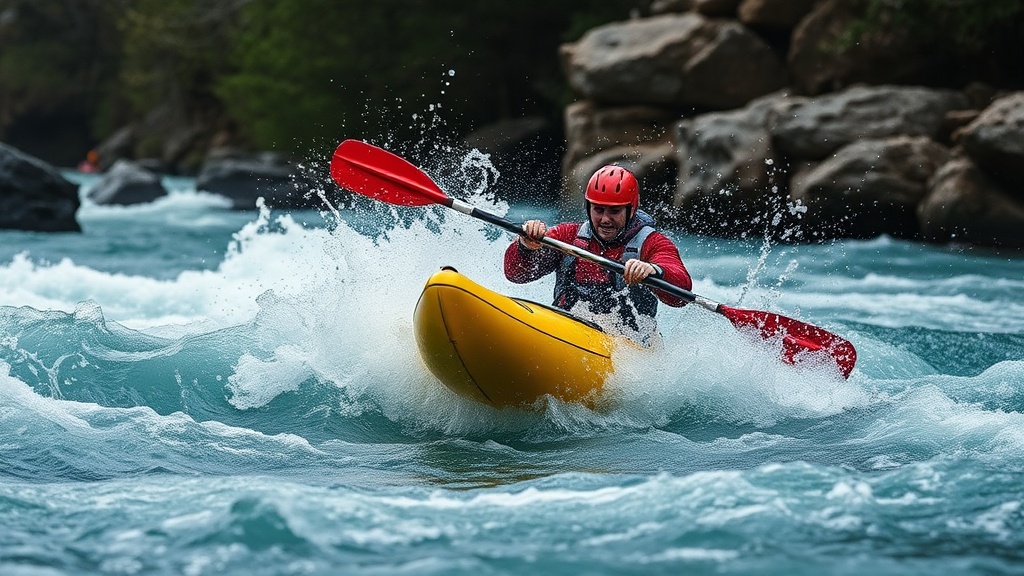
Why Anti-Rotation Drills Should Anchor Your Whitewater Fitness Plan

Picture yourself mid-rapid — your raft drops into a trough, water crashes over the bow, and your guide calls for a hard river-left draw. You plant your paddle, engage your core, and... your torso twists uncontrollably. The stroke loses power. The raft spins. What happened? Your core failed to resist rotation when it mattered most. And that's exactly what this post covers: why anti-rotation training — not just crunches and planks — separates paddlers who thrive on heavy water from those who simply survive it.
Most rafters train their core for movement. They do Russian twists, medicine ball throws, and rotational woodchops. These exercises have value — paddling is fundamentally a rotational sport. But here's what the river actually demands: the ability to prevent unwanted rotation while generating force through your upper body. When water hits your paddle blade with hundreds of pounds of force, your core must lock down and transfer that energy to the boat. If your midsection rotates even slightly, you leak power. Worse, you set yourself up for compensatory patterns that strain your lower back and shoulders.
What Is Anti-Rotation Training — and Why Do Rafters Need It?
Anti-rotation training develops your ability to resist rotational forces acting on your body. Think of it as creating a stable platform from which you can paddle powerfully. When you perform a high brace or execute a sweep stroke through turbulent water, your core isn't initiating the movement — it's stabilizing against the water's attempt to twist your torso.
The mechanics are straightforward but often misunderstood. Your obliques, transverse abdominis, and deep spinal stabilizers work isometrically to maintain torso alignment while your arms and shoulders generate movement. Without this foundational stability, you compensate by overusing your lower back or relying on arm strength alone. Neither strategy works for long river days.
Research published in the Journal of Strength and Conditioning Research demonstrates that core stability training significantly improves force transfer efficiency in rotational athletes. For paddlers, this translates directly to more powerful strokes with less perceived effort. You stop fighting the water and start working with it.
Which Anti-Rotation Exercises Transfer Best to River Performance?
Not all core exercises serve the same purpose. Crunches flex your spine — useful for getting out of bed, irrelevant for paddling. Standard planks build endurance in a static position — better, but still incomplete. You need exercises that challenge your core to resist rotation while your limbs move, mimicking the actual demands of paddling.
Pallof Press: Stand perpendicular to a cable machine or resistance band attached at chest height. Hold the handle at your sternum, step away to create tension, and press your arms straight forward. The band wants to rotate your torso toward the anchor point. Your job is to resist. Start with 3 sets of 10 reps per side, focusing on perfect alignment rather than heavy resistance.
Suitcase Carry: Grab a heavy kettlebell or dumbbell in one hand and walk. Simple, right? Except your entire core must engage to keep your torso upright and prevent lateral flexion and rotation. The asymmetrical load creates the same stability demands as bracing against an uneven current. Walk 40 yards, switch hands, repeat for 3-4 rounds.
Half-Kneeling Landmine Press: Kneel with one knee down, the opposite foot forward. Hold the end of a barbell (in a landmine attachment or corner) at shoulder height on the side of your down knee. Press overhead. The offset load tries to rotate your torso — your core prevents it. This builds single-side stability that directly transfers to paddling on your dominant and non-dominant sides.
Bird Dog with Band Resistance: The classic bird dog (opposite arm and leg extension from a quadruped position) gets significantly harder when you add a resistance band around your wrists or ankles. The band pulls you toward rotation; your deep core muscles must fire continuously to maintain a neutral spine. Hold each position for 5-10 seconds, 6-8 reps per side.
How Should You Program Anti-Rotation Work for River Season?
Timing and integration matter. Anti-rotation work shouldn't replace your rotational power training — it should support it. Think of anti-rotation as the foundation and rotational movements (like medicine ball throws and paddle-specific drills) as the house you build on top.
During your base training phase (8-12 weeks before river season), prioritize anti-rotation exercises 2-3 times weekly. Perform them early in your workout when your neural drive is highest — these movements demand precise motor control, not just brute force. Pair them with compound lifts: Pallof press before deadlifts, suitcase carries after squats, half-kneeling presses with your upper body work.
As river season approaches, shift toward more dynamic, sport-specific movements. Maintain one anti-rotation session weekly to preserve the stability you've built. The goal isn't to become a gym athlete — it's to develop core integrity that holds up when you're six hours into a multi-day trip and hitting your fiftieth rapid of the day.
Volume should stay moderate. Anti-rotation work creates significant neural fatigue without the muscular burn you feel from high-rep ab circuits. Quality over quantity — three perfect Pallof presses beat ten sloppy ones. Track your ability to maintain form under load and increase resistance gradually. If your hips or shoulders rotate even slightly, the weight is too heavy.
What Mistakes Do Most Rafters Make With Core Training?
The most common error? Treating the core as a prime mover rather than a stabilizer. Rafters do endless sit-ups and hanging leg raises, chasing that burning sensation that feels like progress. But paddling rarely requires spinal flexion under load. It requires the ability to maintain a neutral, stable torso while your extremities generate force.
Another mistake: training only bilateral movements. Squats and deadlifts build great overall strength, but paddling is fundamentally unilateral. Each stroke loads one side of your body asymmetrically. Your training must reflect this reality. Single-arm presses, split squats, and offset carries develop the specific stability patterns that transfer to the river.
Rafters also neglect anti-rotation endurance. It's one thing to hold a Pallof press for ten seconds in a controlled gym environment. It's another to maintain core stability through a twenty-minute rapid where you're bracing, paddling, and adjusting constantly. Build endurance with longer suitcase carries (60+ yards) and isometric Pallof press holds (20-30 seconds) as you approach river season.
"The best paddlers aren't the strongest — they're the most stable. When your core locks down, power flows efficiently from your legs through your torso to your paddle. When it doesn't, you're working twice as hard for half the result." — Professional Rafting Guide Training Manual
Finally, many rafters forget to breathe. Anti-rotation exercises often create so much tension that athletes hold their breath — exactly what you can't do on the river. Practice maintaining stable core engagement while breathing normally. Exhale during the exertion phase of each movement. This skill transfers directly to staying calm and breathing efficiently through challenging rapids.
Can Anti-Rotation Training Actually Prevent River Injuries?
There's compelling evidence that core stability work reduces injury risk in rotational sports. A systematic review in the British Journal of Sports Medicine found that core stability programs significantly decreased the incidence of lower back and shoulder injuries in overhead athletes. For paddlers, who combine rotational demands with overhead reaching, this protection is invaluable.
The mechanism is straightforward: when your core stabilizes effectively, your shoulders and hips move through their intended ranges of motion without compensatory stress. Your rotator cuff muscles work as designed instead of overcompensating for a unstable base. Your lumbar spine maintains neutral alignment instead of twisting under load. Over hundreds of thousands of strokes across a season, this stability prevents the chronic overuse injuries that end many paddling careers prematurely.
Shoulder impingement — one of the most common rafting injuries — often stems from poor scapular control, which depends on thoracic and core stability. Lower back pain frequently results from excessive spinal rotation when the core fails to resist the forces generated during powerful strokes. Anti-rotation training addresses both root causes directly.
Start integrating these movements now, regardless of where you are in your training cycle. If you're mid-season, add one anti-rotation exercise to your existing routine. If you're building base fitness for next year, make anti-rotation a cornerstone of your program. The stability you develop in the gym becomes the confidence you feel when the water rises and the consequences of failure increase.
The river doesn't care about your intentions. It responds to your preparation. Build a core that can handle whatever the current throws at you.