What Muscles Does Whitewater Rafting Actually Work? (Spoiler: It Is Not Just Your Arms)
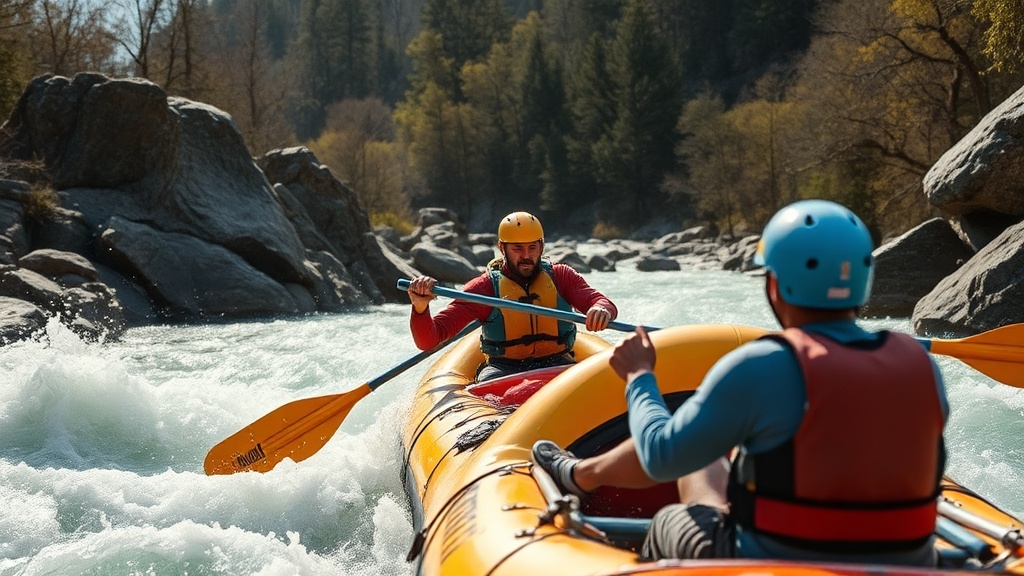
Most people picture whitewater rafting and immediately think of bulging biceps and shredded shoulders powering through churning rapids. That image is everywhere—movies, advertisements, even how guides describe a tough day on the river. But here is the uncomfortable truth: treating rafting as an upper-body sport is a recipe for early fatigue, poor technique, and missed strokes when you need them most. Your arms are merely the delivery system. The real work happens elsewhere.
This guide breaks down exactly which muscle groups drive every paddle stroke, brace, and maneuver in whitewater. More importantly, it explains why understanding these mechanics matters for your training. When you know what is actually firing during a Class IV rapid, you can build a fitness plan that translates directly to better performance—and fewer days spent nursing sore shoulders.
What Role Does Your Core Play During a Paddle Stroke?
Your core is not just along for the ride—it is the engine room. Every forward stroke begins with foot placement against the tube or foot cups. That connection transfers force from your legs through your hips, across your obliques, and into your lats. Your arms? They are essentially rigid levers at that point, holding the paddle shaft while your torso rotates.
Think about a powerful draw stroke to pull the raft sideways. Novices try to muscle it with their shoulders. Experienced paddlers rotate their torsos, engaging the transverse abdominis and internal obliques to pull the blade through the water. That rotation generates significantly more force with less local fatigue. Your rectus abdominis stabilizes against the water's resistance, keeping your upper body connected to the lower half.
The constant bracing required in technical rapids adds another layer of core demand. When the raft drops into a hole or slides across a lateral wave, your body acts as a shock absorber. A weak core means your spine absorbs that impact—and your paddling posture collapses. A strong anterior and posterior chain keeps you upright, balanced, and ready for the next stroke.
Research from the National Institutes of Health on paddling biomechanics confirms that trunk rotation contributes significantly more power than arm pull in canoe and kayak paddling. The same principles apply directly to rafting, where coordinated team strokes require even more torso engagement to synchronize timing.
Why Are Your Legs and Hips the Secret Weapons?
Here is what the arm-focused crowd misses entirely: you cannot generate power from a floating base. Your legs anchor you to the raft. Without that connection, every stroke pushes you backward as much as it pushes the paddle forward.
High-framed rafts require constant leg engagement to maintain balance. Your quadriceps and hip flexors work isometrically to hold your seated position against lateral forces. When the guide calls for a high-side—you lean into the tube to prevent flipping—your adductors and glutes fire hard to keep your hips low and your weight where it needs to be.
The hips also drive steering. A sweep stroke or stern draw requires hip rotation to position the paddle correctly. Tight hip flexors limit that range of motion, forcing compensatory shoulder movement that reduces efficiency and increases injury risk. Dynamic river conditions—eddies, reversals, laterals—demand constant micro-adjustments from your lower body to stay balanced while your upper body executes technique.
According to the American Canoe Association, proper paddling technique emphasizes the "power triangle" formed by your arms and torso—but that triangle only works when your lower body provides a stable platform. Their instructional materials consistently stress leg drive and hip rotation over arm strength for sustainable paddling.
The Posterior Chain You Are Probably Neglecting
Your backside does more work than you realize. The latissimus dorsi—often called the "lats"—are the primary muscles pulling the paddle through the water. But they do not work alone. Your rhomboids and middle trapezius muscles stabilize your shoulder blades, keeping the paddle path straight and efficient.
Lower down, your erector spinae maintains spinal extension during forward strokes. In a seated position, these muscles fight gravity and water resistance to keep your posture upright. After a long day on the river, that deep lower-back fatigue you feel? That is your erectors talking. Deadlifts, rows, and pull-ups in your training program directly strengthen this chain.
How Do Your Grip and Forearms Handle the Load?
Your grip is your connection to the paddle. No amount of leg drive or core rotation matters if your hands cannot hold the shaft under load. Whitewater paddles are not light—especially wooden or high-end carbon models with substantial blades. Add water resistance and the need for quick transitions between strokes, and your forearms end up working overtime.
The forearm flexors control finger grip and wrist stabilization. During a hard draw or brace, these muscles contract hard to prevent the paddle from twisting in your hands. Your extensors work antagonistically to maintain wrist position—too much flexion and you lose power; too much extension and you strain the joint.
Grip endurance often fails before larger muscle groups. You see it on long flatwater sections or extended technical rapids: paddlers start "choking" the paddle, white knuckles showing, forearms pumped and useless. That is local muscular fatigue—your cardiovascular system might be fine, but your grip has tapped out. Training grip specifically (farmer's carries, dead hangs, wrist roller work) extends your effective paddling time significantly.
Which Supporting Muscles Keep You Safe and Efficient?
Beyond the prime movers, several smaller muscle groups deserve attention. Your rotator cuff muscles—supraspinatus, infraspinatus, teres minor, and subscapularis—stabilize the shoulder joint during every stroke. Poor cuff strength leads to impingement, tendonitis, and the dreaded "paddler's shoulder."
Your neck muscles work constantly to track the river, spot obstacles, and coordinate with your team. Stern paddlers especially spend hours with heads rotated, scanning downstream. That creates unilateral tension that can trigger headaches and upper-back pain if not addressed.
Even your feet and ankles matter. Barefoot or in minimal water shoes, your intrinsic foot muscles grip the raft tubes or foot cups. That grip feeds into the kinetic chain, helping with balance and power transfer. Cold water numbs these small muscles quickly—a factor many paddlers underestimate until they find their footwork sloppy late in the day.
The British Canoeing organization emphasizes shoulder health and injury prevention in their coaching materials, noting that repetitive paddling motions without adequate rotator cuff conditioning frequently lead to overuse injuries that bench paddlers for entire seasons.
Putting It Together: Movement Patterns Over Isolation
Effective training does not isolate these muscles—it trains them to fire together. A Turkish get-up hits your core, shoulder stability, and hip mobility simultaneously. A heavy farmer's carry builds grip while challenging your erectors and core bracing. Rowing intervals develop cardiovascular capacity while reinforcing the exact pulling pattern you use on the water.
The misconception that rafting is an arm workout persists because arms are visible. You see them moving. You feel the burn first. But the real performance limiters hide in your core stability, leg drive, and posterior chain endurance. Train those—and your arms will simply do their job instead of carrying the entire load.