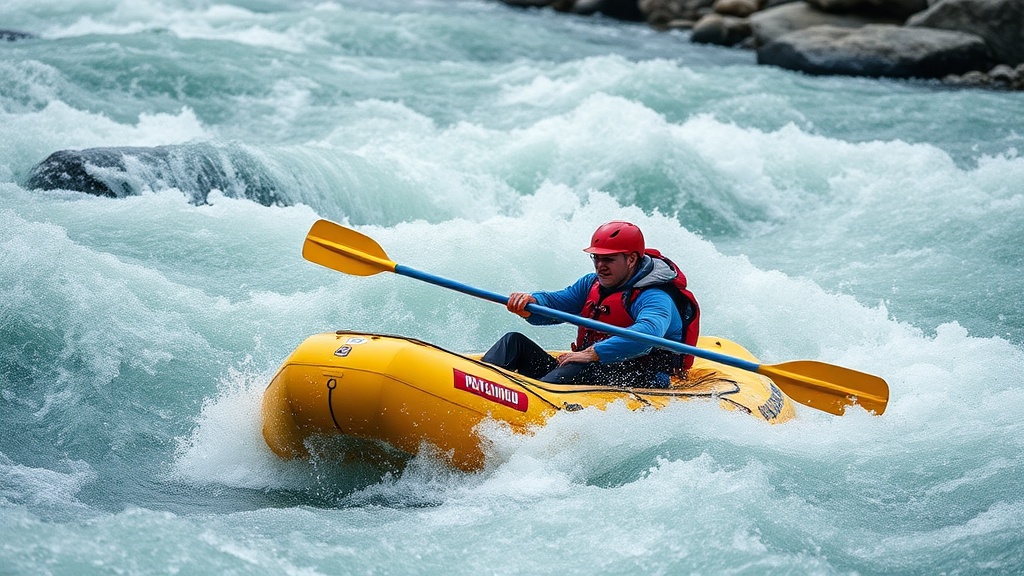
How to Train for Whitewater Rafting: A Complete Fitness Guide

This guide covers the specific strength, endurance, and technical conditioning required to paddle challenging rapids safely — from pool training and gym work to on-river preparation. Whitewater rafting demands more than weekend-warrior fitness; unprepared paddlers risk shoulder injuries, exhaustion halfway through a run, and missed strokes when it matters most. Whether you're planning a Class III day trip on the Ottawa River or a multi-day expedition through the Grand Canyon, the right training separates a thrilling adventure from a miserable struggle against the current.
What Muscles Are Used Most in Whitewater Rafting?
The primary muscles engaged during rafting are the latissimus dorsi (lats), shoulders, core, and forearms — with your legs and hips providing stabilization and bracing power. It's not just an upper-body sport. Your entire kinetic chain works together to keep you balanced, transfer paddle power efficiently, and absorb the impact of hitting waves.
Your lats and rear deltoids drive the paddle stroke. Every time you plant the blade and pull, those muscles fire hard. Your core — particularly the obliques and transverse abdominis — rotates your torso and protects your lower back during bracing maneuvers. Forearms and grip strength? You'll understand their importance about twenty minutes into a technical rapid when your hands start cramping around the T-grip.
Legs matter more than most beginners realize. You're wedged into foot cups or anchored on the tube, using quadriceps and hip flexors to maintain a stable base. Without that foundation, your paddle strokes lose power and precision. Here's the thing: training only your arms ignores half the equation.
How Long Should You Train Before a Whitewater Rafting Trip?
Begin a structured training program at least 6-8 weeks before your trip, with 3-4 sessions per week combining strength, cardio, and paddling-specific work. Shorter timelines help, but six weeks gives your body time to adapt without overtraining.
Break it down by fitness level. If you're already active — hitting the gym regularly, maybe cycling or running — four weeks of rafting-specific conditioning suffices. You'll focus on translating that general fitness to paddling movements. Complete beginners need the full eight weeks (minimum) to build baseline strength and avoid injury.
The catch? Whitewater rafting has an unpredictable element. You can't train for every scenario in a gym. What you can do is build the physical reserves to handle surprises — the unexpected swim, the long paddle out of an eddy, the hold-on-and-pray moment when a hole tries to keep your raft.
Sample 6-Week Training Progression
| Week | Focus | Key Sessions |
|---|---|---|
| 1-2 | Base Building | 2 strength, 2 cardio, technique practice |
| 3-4 | Intensity | 3 strength, 2 cardio, 1 pool session |
| 5 | Peak | 3 strength, 2 intervals, 2 pool sessions |
| 6 | Taper | 2 moderate strength, 1 interval, river trip prep |
What Strength Exercises Prepare You for Rafting?
The most effective strength exercises for rafting include pull-ups, rows, kettlebell swings, planks with rotation, and farmer's carries — movements that build pulling power, core stability, and grip endurance. You don't need fancy equipment. A basic gym membership or home setup works fine.
Pull-ups remain the gold standard. Can't do a full pull-up yet? Use resistance bands or a machine assist. Aim for 3 sets of 8-12 reps, building toward unassisted bodyweight reps. These directly strengthen the exact muscles you'll use for every forward stroke.
Single-arm dumbbell rows develop unilateral strength and core anti-rotation — critical when you're paddling on one side during a ferry or trying to hold a line. Use the Rogue Rubber Hex Dumbbells (25-45 lbs works for most trainees) and focus on controlled movement, not momentum.
Kettlebell swings — specifically with a 16-24 kg kettlebell from Kettlebell Kings or Rogue — build hip power and cardiovascular conditioning simultaneously. The hip hinge pattern translates directly to bracing against the tube and transferring power from your legs through your core.
Worth noting: traditional bench pressing isn't a priority. You need pulling strength far more than pushing. That said, include some push-up variations for shoulder stability and to balance your programming.
Core Training for River Stability
Your core isn't just abs. It's the entire cylinder — front, back, and sides — keeping you upright when the raft tilts. Skip the crunches. They don't replicate anything you'll do on the river.
Instead, prioritize:
- Pallof presses — anti-rotation training using a cable machine or resistance band
- Side planks with hip dips — builds oblique endurance for sustained paddling
- Dead bugs — lumbar stability without spinal flexion
- Turkish get-ups — full-body coordination and shoulder stability (use a moderate kettlebell)
Perform core work 3-4 times weekly, either as a finisher to strength sessions or on active recovery days. Two to three sets of 45-60 seconds per exercise hits the mark.
How Important Is Cardiovascular Fitness for Rafting?
Cardiovascular fitness is extremely important — long rapids, high-water conditions, and self-rescue situations demand sustained aerobic capacity and quick recovery between intense bursts. You need both steady-state endurance and anaerobic power.
Running works. So does cycling, rowing, or swimming. The key is variety. Long slow distance (LSD) training — 45-60 minutes at conversational pace — builds your aerobic base. High-intensity interval training (HIIT) — 30 seconds hard, 90 seconds easy, repeated 8-10 times — develops the anaerobic capacity to handle big hits and recover quickly.
The Concept2 Rowing Machine offers the closest simulation to paddling. It engages the same posterior chain muscles and grip demands. If you have access to one (most commercial gyms carry them), substitute one cardio session weekly with 20-30 minutes of rowing intervals. Aim for a 2:00-2:15 split per 500m at moderate intensity.
Swimming deserves special mention. It's low-impact, builds shoulder endurance, and — here's the practical angle — prepares you for the possibility of swimming a rapid. Practice front crawl, breaststroke, and backstroke. Comfort in the water isn't optional for serious rafting.
Training on Flat Water
Nothing replaces actual paddle time. If you live near a lake, river, or calm bay, get on the water with a kayak, paddleboard, or inflatable raft. The AIRE Force inflatable kayaks (IKs) offer an accessible entry point for flat-water training that transfers directly to whitewater skills.
Paddle for 60-90 minutes at varying intensities. Practice the forward stroke, sweep strokes, and draw strokes. Focus on torso rotation — your core should drive the movement, not your arms. Film yourself or paddle with experienced partners who can correct your form.
That said, flat-water skills differ from whitewater. The current changes everything. Consider taking a course with NOLS or a local outfitter before tackling serious rapids.
What Gear and Recovery Strategies Support Your Training?
Quality gear and proper recovery prevent overuse injuries and keep your training consistent — invest in a good paddle, supportive footwear, and prioritize sleep and nutrition alongside your workouts. The best program fails if you're constantly sore, injured, or under-fueled.
For gym training, the Rogue Kettlebell line offers durable cast iron options that'll outlast your training cycle. A set of resistance bands (Rogue or serious steel from EliteFTS) assists with pull-up progression and adds rotational work. For footwear, the Astral Brewer 2.0 water shoes work on land and river — grip when wet, drainage holes, and enough support for light trail use.
Recovery means sleep (7-9 hours), hydration (half your body weight in ounces daily, minimum), and protein intake (0.7-1g per pound of bodyweight). Foam rolling and basic mobility work — hip flexor stretches, thoracic spine rotations, shoulder dislocates — keep your shoulders and lower back healthy through high-volume training.
The catch? Most people ignore recovery until something hurts. Don't. Schedule at least one full rest day weekly. If you're feeling beat up, swap a hard session for yoga or a long walk. The river will still be there — you need to arrive unbroken.
Mental Preparation Matters Too
Physical fitness opens the door. Mental composure walks you through. Whitewater triggers adrenaline dumps, rapid breathing, and tunnel vision — none of which help you read the river or execute techniques.
Practice controlled breathing during hard training sets. Box breathing (4 seconds in, hold, out, hold) calms your nervous system. Visualize river scenarios: flipping in a rapid, swimming to an eddy, helping a fellow paddler. The mind-body connection separates confident rafters from anxious ones.
"The river doesn't care about your excuses. It only cares whether you're ready."
Train hard. Recover smart. Show up prepared. The whitewater rewards those who respect it — and put in the work before they ever see their first rapid.
Steps
- 1
Build Core Stability for Balance and Control
- 2
Develop Upper Body Strength for Powerful Paddling
- 3
Increase Cardiovascular Endurance for Long River Runs