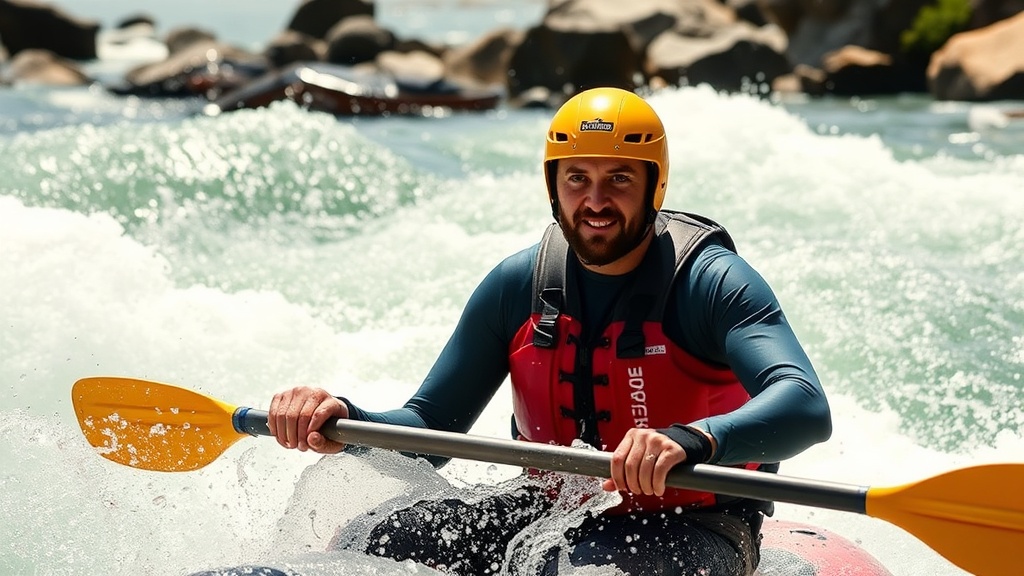
How to Condition Your Body for Class IV and V Rapids

Why Strength Alone Won't Save You in Big Water
Most rafters think raw power—the kind you build with deadlifts and pull-ups—is what separates those who handle Class IV rapids from those who swim. That's wrong. The real difference isn't how much you can lift. It's how well your body handles chaotic, multi-directional forces while fatigued, cold, and making split-second decisions. This guide covers the specific physical preparation that actually matters when the river gets serious—training that builds reactive stability, interval tolerance, and the joint resilience to withstand repeated impacts. If you're tired of feeling beaten up after big water days (or worse, holding your crew back), here's what needs to change in your conditioning.
What Muscles Should You Train for Big Rapids?
Whitewater rafting demands an unusual combination of pulling power, rotational strength, and isometric endurance. Most gym programs miss two-thirds of this equation.
The pulling chain—lats, rhomboids, rear deltoids, and biceps—gets obvious attention. You're pulling water all day. But here's what most rafters ignore: your pulling strength matters less than your ability to maintain repeated pulls at 60-70% of your maximum while breathing hard. One powerful stroke won't save you in a hole. Twenty controlled strokes will.
Train this with density work. Set a timer for 10 minutes. Perform inverted rows or chest-supported rows with moderate weight—something you could lift for 12-15 reps fresh. Complete 5 reps every 30 seconds. When your form breaks, stop. That's your baseline. Over weeks, work toward completing all 20 sets. This builds the specific type of pulling endurance that translates directly to sustained paddling through long rapids.
Rotational power comes from your obliques, serratus anterior, and the fascial slings connecting your hips to opposite shoulders. Standard crunches won't touch this. You need exercises that force your torso to resist and generate rotation under load.
Pallof presses (anti-rotation), cable woodchops (rotation generation), and single-arm farmer's carries (rotational stability) should form your core triad. Perform 3 sets of 8-12 reps for the first two, and 3 carries of 40-50 meters per side. The carry is particularly valuable—it mimics the asymmetrical loading of a paddle in one hand while your body fights to stay upright in moving water.
The posterior chain—hamstrings, glutes, lower back—protects your spine during bracing and high-seat positions. Romanian deadlifts and kettlebell swings (hip-dominant, not squat-dominant) should be staples. These muscles also generate the hip snap that drives powerful forward strokes when you need to punch through a hydraulic.
How Do You Build Cardio Without Losing Strength?
Traditional steady-state cardio—long runs, bike rides—won't prepare you for whitewater. River days involve intense 30-90 second efforts (a rapid) followed by brief recovery (the calm section), repeated for hours. You need interval conditioning that mirrors this.
Energy system training for rafting breaks into two categories. Alactic power intervals (10-15 seconds all-out, 2-3 minutes rest) develop the immediate energy system used for high-intensity strokes—the kind you need when punching a hole or making a must-make move. Use assault bike sprints, rowing sprints, or kettlebell swing intervals. The key is complete recovery between efforts. Incomplete rest trains a different energy system—and not the one you need.
Lactic power intervals (45-90 seconds hard, 3-4 minutes rest) build tolerance to the burning fatigue that sets in during long rapids or when you're stuck in a hole trying to work free. These are mentally tough—and that's the point. Rowing or skiing ergometer work at 85-90% effort teaches you to maintain technique when everything burns. One session weekly is sufficient for most rafters.
The real magic happens in mixed modal circuits that combine cardiovascular stress with technical movements. Try this: 500-meter row, 10 pull-ups, 20 goblet squats, 30-second plank hold. Rest 90 seconds. Repeat 4-6 rounds. The rowing elevates your heart rate; the strength work forces you to control breathing and maintain form while fatigued—exactly what river running demands.
A word on interference: excessive cardio can blunt strength gains. The solution is timing and specificity. Do your interval work on separate days from heavy lifting, or at least 6 hours apart. Keep high-intensity cardio sessions under 30 minutes total. Your goal isn't marathon fitness—it's the ability to perform repeated explosive efforts without gassing out.
What Joint Prehab Keeps You on the River Longer?
Shoulders, elbows, and lower backs—these are where rafters break down. Not dramatically, usually. Just a gradual accumulation of irritation that eventually keeps you off the water. Addressing this requires targeted work that most training programs skip entirely.
Shoulder health depends on rotator cuff endurance and scapular control. Your rotator cuff isn't built for heavy loads—it's built for maintaining joint position through thousands of repetitions. External rotation work with bands (3 sets of 15-20 reps) and face pulls should be daily habits, not occasional afterthoughts. Before any upper body training or paddling, perform scapular pull-ups: hang from a bar and actively depress your shoulder blades without bending your elbows. 2 sets of 10. This wakes up the muscles that protect your shoulders during heavy pulling.
Elbow issues (medial epicondylitis, the climber/rafter curse) stem from grip and wrist flexor overuse without balancing extensor work. Reverse wrist curls, finger extension with rubber bands, and rice bucket exercises (opening and closing your hand in a bucket of rice) provide the antagonist strength that prevents overuse injuries. Spend 5 minutes on this after every paddling session. It's boring. It works.
Lower back resilience in rafting comes from two sources: anterior core strength (to prevent overextension while bracing) and hip mobility (to allow your hips to move without forcing your spine to compensate). Dead bugs, bird dogs, and Copenhagen planks should rotate through your weekly training. For hip mobility, prioritize 90/90 stretches and cossack squats—positions that mimic the wide-stance bracing you do in a raft.
Cold water exposure—common in early-season paddling—reduces joint temperature and increases injury risk. A proper warm-up before getting on the water isn't optional. Dynamic leg swings, arm circles, and torso rotations increase tissue temperature and joint lubrication. Take 5 minutes on shore. Your connective tissue will thank you.
How Should You Periodize Training Around River Season?
Random training produces random results. A simple periodization model aligns your physical preparation with when you actually need it.
Off-season (late fall through winter): Build general strength and address imbalances. This is when you lift heavier—3-5 sets of 5-8 reps for major movements. Increase calories slightly to support muscle growth. Prioritize sleep and recovery; your body adapts during rest, not work.
Pre-season (6-8 weeks before first trips): Shift toward specific conditioning. Reduce strength work to 2 sessions weekly (maintaining, not building). Increase interval training and add sport-specific movements like paddle ergometer work if you have access. Start cold-water exposure training—cold showers progressing to ice baths—to build brown fat activation and cold tolerance.
In-season: Maintenance mode. One strength session weekly to preserve gains. Prioritize recovery: mobility work, adequate protein (0.7-1g per pound of bodyweight), and sleep. Your river days are your conditioning now—don't bury yourself with excessive gym work.
Track subjective readiness. Rate your energy, soreness, and motivation 1-10 each morning. When two or more metrics drop below 6 for multiple days, you're under-recovered. Reduce training volume 40% for one week. This prevents the overreaching that leads to illness or injury right when the river is running best.
Sample Weekly Training Template
Here's a practical week for an intermediate rafter preparing for big water:
Monday: Strength—Pulling focus. Rows, pull-ups, face pulls, deadlifts. 45 minutes.
Tuesday: Intervals—Lactic power. 6 rounds: 60-second assault bike sprint, 3 minutes rest.
Wednesday: Strength—Pushing and rotation. Push-ups or presses, Pallof presses, woodchops, single-leg work. 45 minutes.
Thursday: Active recovery. 20-minute easy swim or yoga. Joint prehab circuit.
Friday: Mixed modal. 5 rounds: 400m row, 8 pull-ups, 12 kettlebell swings, 30-second plank.
Saturday: River day or paddle-specific endurance (2-3 hours low-intensity paddling if possible).
Sunday: Full rest or gentle mobility.
Adjust volume based on your river schedule—never sacrifice water time for gym time when you're in season. The best training for rafting is rafting. The gym just prepares you to do it better and longer.
For authoritative guidance on exercise technique and programming, refer to resources from the National Strength and Conditioning Association. For shoulder health protocols specific to overhead athletes, the Stop Sports Injuries initiative provides research-backed prevention strategies. Additional conditioning insights for paddle sports can be found through British Canoeing's knowledge base.