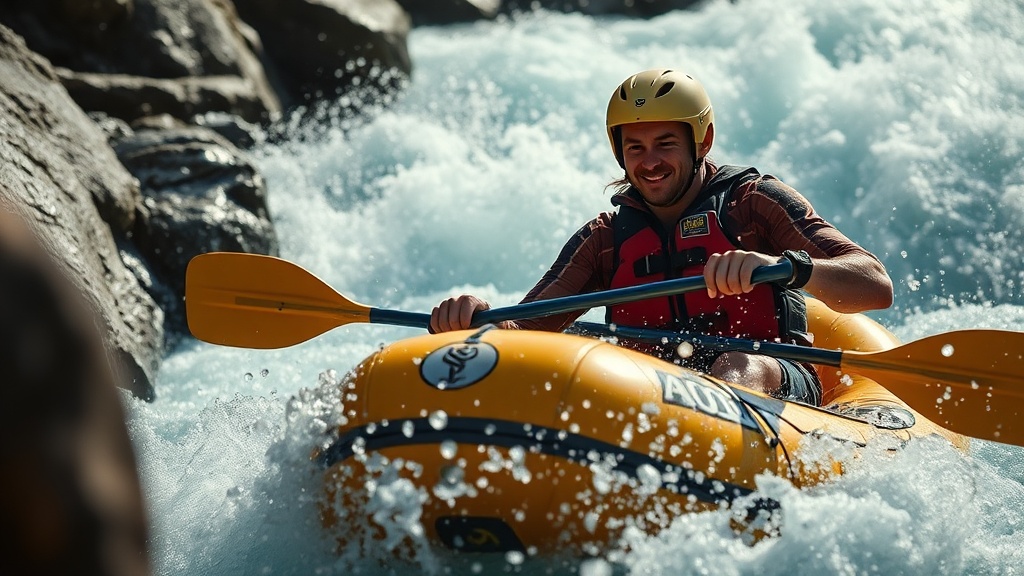
Essential Upper Body Training for Whitewater Rafting Success

Whitewater rafting demands explosive pulling power, sustained grip endurance, and core stability that transfers directly to paddle control. This guide breaks down the specific upper body movements that prepare you for Class III rapids and beyond — covering exercise selection, training frequency, and recovery protocols that actually move the needle on river performance.
What Muscles Do You Need for Whitewater Rafting?
The primary movers are your lats, rear deltoids, and biceps — the muscles that pull water and stabilize your torso against current forces. Your forearms and grip matter just as much; pump out early on a multi-day trip and you're fighting an uphill battle against the river.
The secondary system — rotator cuffs, rhomboids, and lower traps — keeps your shoulders healthy under repetitive strain. Ignore these smaller muscle groups and you're looking at impingement issues halfway through the season. Here's the thing: most gym routines focus on pressing movements (bench, overhead press) that create muscle imbalances. Rafters need the opposite — a 2:1 ratio of pulling to pressing volume.
Your core connects everything. It's not "upper body" in the strict sense, but without anti-rotation stability, no amount of lat strength saves you when a hydraulic hits the raft broadside. The exercises below integrate core engagement by default.
What Are the Best Exercises for Whitewater Rafting Strength?
Compound pulling movements form the foundation — specifically deadlifts, pull-ups, and rows with varied grips that mimic paddle handling positions.
The Pull-Up (And Its Variations)
Standard pull-ups build lat width and pulling power. For rafting specificity, vary the grip monthly:
- Wide grip: Emphasizes lat development for long, powerful paddle strokes
- Neutral grip: Easier on shoulders during high-volume training phases
- Commando pull-ups: Side-to-side movement mimics the torso rotation you'll use when drawing a paddle across the bow
Can't do bodyweight reps yet? Use a Rogue Monster Band for assisted reps — avoid the graviton machine. The band keeps your stabilizers working; the machine doesn't.
Deadlifts and Variants
Trap bar deadlifts should be your bread and butter. The grip position (neutral, at your sides) transfers better to paddling than conventional barbell deadlifts. Start with three sets of five at a weight that leaves two reps in reserve.
Romanian deadlifts have a place too — not for the posterior chain alone, but for grip endurance. Hold the bar for a three-second pause at the bottom of each rep. That time-under-tension builds the forearm capacity you'll need on day two of a Gauley River trip.
Rowing Patterns
One-arm dumbbell rows with the Rogue Rubber Hex Dumbbells allow torso rotation that mirrors real paddling mechanics. Chest-supported rows (using a bench) eliminate momentum and force scapular retraction — the exact position you need when bracing through a rapid.
Worth noting: seated cable rows have limited carryover. The fixed hip position doesn't replicate the dynamic stance of a rafter. Stick to free-weight variations when possible.
Direct Grip Work
Farmer's carries with thick-grip implements should finish every upper body session. Walk 40 yards with 75-100% of your body weight (total, split between both hands). Use Fat Gripz on standard dumbbells if you don't have axles or farmer's walk handles.
Hang from a pull-up bar for time — not active hangs, just dead hangs. Accumulate three minutes total, broken into as many sets as needed. This decompresses the spine after heavy pulling and builds the connective tissue resilience that prevents elbow and shoulder issues.
How Should You Structure a Rafting-Specific Training Program?
Frequency beats intensity. Four moderate sessions per week outperform two brutal ones — you'll recover better and keep technique sharp.
Here's a sample weekly structure:
| Day | Focus | Primary Movements | Volume |
|---|---|---|---|
| Monday | Horizontal Pulling | Barbell row, chest-supported row, face pulls | 4x6, 3x10, 3x15 |
| Tuesday | Vertical Pulling | Weighted pull-ups, lat pulldowns (neutral grip), shrugs | 5x5, 3x12, 3x12 |
| Thursday | Hinge & Grip | Trap bar deadlift, RDL, farmer's carry, dead hangs | 3x5, 3x8, 3x40yd, 3x60s |
| Friday | Accessory & Prehab | External rotations, direct bicep/tricep work, core | High reps, controlled tempo |
The catch? Most people go too heavy, too often. Your connective tissues adapt slower than muscles. Schedule a deload week — 50% volume, same exercises — every fourth week. Skip this and you're gambling with tendon health when the spring melt hits.
Periodization for Seasonal Readiness
Structure your year in blocks. Winter (December–February) is general preparation — higher volume, moderate intensity, building work capacity. Spring (March–May) shifts toward specific preparation — heavier loads, reduced volume, emphasizing power development. Summer is maintenance — two sessions weekly to preserve strength while you're actually on the water.
That said, don't abandon training entirely during peak season. One short session weekly prevents the detraining that leaves you vulnerable late in the summer. Focus on grip work and rotator cuff health — the areas that deteriorate fastest with high river mileage.
What About On-Water Training?
Flatwater paddling with deliberate technique beats gym work for specific skill development — but it won't build the strength ceiling you need for big water. Use both.
Try this: once weekly, perform interval paddling. Three-minute hard efforts (85% perceived exertion), one minute rest, repeat six times. The stroke rate should mirror what you'd use in Class IV water — powerful, deliberate, not rushed.
Pool sessions have value too. The NRS Paddle Series offers shaft variations that let you practice with the exact equipment you'll use on the river. Shorten your grip occasionally — this overloads the hands and forearms, building grip endurance faster than standard-length paddling.
Recovery Strategies That Actually Work
Training breaks tissue down; recovery builds it back stronger. Most rafters under-recover.
Sleep is non-negotiable. Seven hours minimum — eight if you're in a heavy training block. Growth hormone peaks during deep sleep, and that's when tendon remodeling happens. Skip sleep and you're not just tired; you're structurally weaker.
Protein intake should hit 0.7–1 gram per pound of body weight daily. Spread across four meals if possible — muscle protein synthesis stays elevated longer with multiple feeding windows. You don't need supplements, but Thorne Meriva SF (a curcumin formulation) can help with inflammation management during high-volume phases.
Soft tissue work matters for the paddling population specifically. Lacrosse ball rolling for the teres minor and infraspinatus — the deep rotator cuff muscles that take a beating during high-angle brace strokes. Two minutes per side, post-training.
Gear Recommendations for Training
You don't need much. A quality pull-up bar (the Rogue P-4 Pull-Up System mounts securely to wall studs), a trap bar, and adjustable dumbbells cover 90% of your needs. Add Fat Gripz and resistance bands for assistance and prehab work.
For on-water training, the Werner Powerhouse remains the standard for whitewater paddles — fiberglass shaft, responsive blade, sized correctly to your height and boat width. A paddle that's too long forces shoulder impingement; too short costs power. Werner's sizing chart is accurate — use it.
"Strength is never a weakness. In rafting, it's the margin between control and chaos when the river decides to test you." — Scott Shipley, Olympic slalom paddler and expedition guide
Start now. The spring runoff waits for no one, and the river doesn't care what your excuse was.