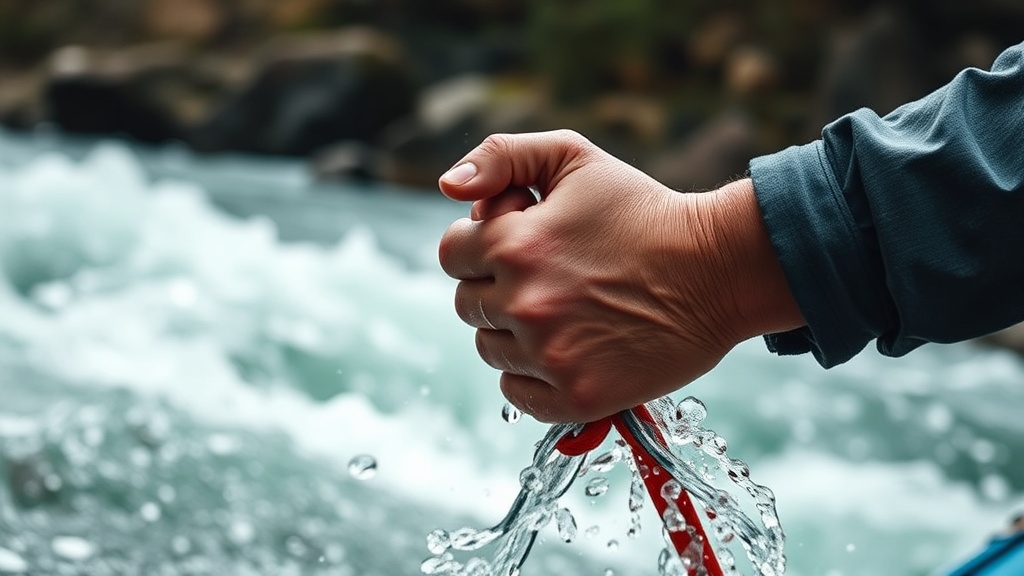
Building Grip Strength and Forearm Endurance for Long River Days
What drives fatigue in your hands during a long run?
This post covers the specific mechanics of grip fatigue and how to build the forearm endurance required to keep a paddle steady when the water gets heavy. You'll learn why your hands often fail before your core does, and how to train your grip to prevent premature fatigue during high-intensity paddling sessions.
Most people focus on the big muscle groups—the lats, the core, and the quads—when preparing for a river trip. They forget that your connection to the boat is entirely dependent on your hands. If your grip fails, your technical skill becomes irrelevant. You can't execute a precise stroke or a strong brace if your fingers are cramping or your forearms feel like they're on fire. It's a frustrating way to lose control of a raft, especially when the rapids are peaking.
The issue isn't just about raw strength; it's about local muscular endurance. High-intensity paddling requires a constant, varying level of tension. You aren't just holding a stick; you're reacting to the vibration of the water, the pull of the current, and the sudden jolts of a heavy hit. This constant micro-adjustment drains the glycogen stores in your forearms faster than you might realize. Without specific training, you'll find yourself struggling to hold the shaft securely during the final stretch of a long descent.
How can I increase my grip endurance?
To build a grip that survives a full day on the water, you need to move beyond simple squeezing exercises. You need to train for stability and sustained tension. A common mistake is only doing heavy, low-rep lifts. While that builds raw power, it doesn't help much when you're 40 minutes into a heavy draw. Instead, incorporate time-under-tension training into your routine.
- Farmer Carries: Grab the heaviest dumbbells or kettlebells you can safely handle and walk for distance. This builds the structural integrity of your grip.
- Dead Hangs: Find a pull-up bar and just hang. Try to increase your time by five seconds every week. This builds the endurance of the small muscles in your hands.
- Towel Pull-ups: Instead of a standard bar, drape a towel over a bar and hold onto the fabric. This mimics the awkward, non-rigid grip of a paddle shaft.
If you want to see the physiological impact of these movements, the benefits of grip strength are well-documented in the broader fitness community. It's not just about the hands; it's a marker of overall physical capability.
What exercises work best for paddle-specific strength?
Paddling isn't a static grip. It involves a lot of rotational torque. Your grip needs to be able to handle the paddle twisting in your hands as you fight a current. To prepare for this, you should look toward tools that challenge your stability. A thick bar or a "fat grip" attachment on a barbell is an excellent way to simulate the increased surface area and the strain of a heavy stroke. This forces your forearm muscles to work harder to keep the object stable.
Consider using a grip strengthener that allows for different tension levels. However, don't just do rapid-fire squeezes. Focus on slow, controlled movements. If you're using a grip trainer, try holding the squeeze at the peak of the contraction for three to five seconds. This builds the isometric strength that is so vital when you're bracing against a heavy wave and the boat is bucking underneath you.
Another way to build this specific type of endurance is through rotational work. Using a single kettlebell for certain movements can force your grip to adapt to shifting centers of gravity. This mimics the feeling of a paddle being yanked by a heavy eddy or a rogue wave. It keeps your hands and wrists prepared for the unpredictable nature of whitewater.
Why does my forearm cramp during rapids?
Cramping is often a sign of two things: local muscular fatigue and electrolyte depletion. If your forearms are seizing up, it's usually because the muscle fibers are exhausted from the constant tension. However, don't ignore the role of hydration. As noted by the importance of hydration, your muscles need a proper balance of minerals to function. If you're low on magnesium or potassium, your muscles will misfire much sooner.
To prevent this, treat your forearm training as a part of your overall conditioning. Don't just train for a single heavy lift; train for the ability to sustain a moderate load over a long duration. Think of your grip as a component of your endurance. If you can hold a heavy weight for a minute, you'll have a much easier time holding a paddle for an hour.
One thing to keep in mind is the psychological aspect. When your hands start to hurt, your brain starts to tell you to relax your grip. This is a mistake. A loose grip leads to a loss of control. By training your endurance, you build the mental confidence to hold your line even when the physical sensation of fatigue sets in. You want your hands to be the last thing on your mind, not the first.
Keep your training varied. One day, focus on heavy, low-rep strength to build the foundation. The next, focus on high-rep, low-weight endurance and stability. This variety ensures you aren't just strong, but also resilient against the specific stresses of the river environment.