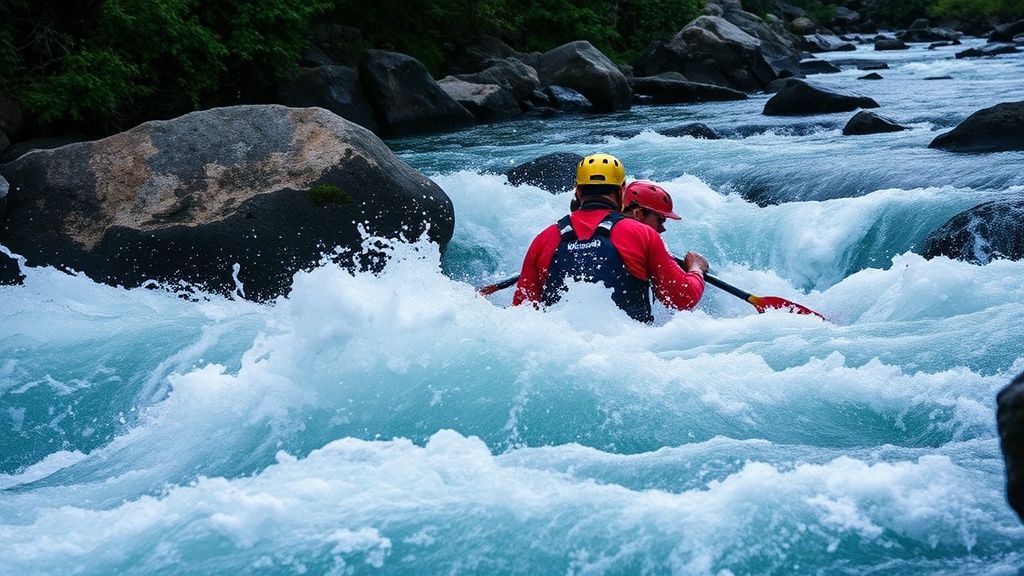
5 key Training Tips for Conquering Class IV Rapids

Master the Forward and Draw Stroke Fundamentals
Build Core Strength for Stability in Rough Water
Practice Swift Water Rescue Techniques Regularly
Develop Situational Awareness for Reading Rivers
Condition Your Body with Paddle-Specific Endurance Training
Class IV rapids demand more than enthusiasm. They punish the unprepared with long swims, bruised bodies, and genuine danger. This guide breaks down five training fundamentals that separate confident paddlers from weekend warriors who bite off more than they can chew. You'll learn specific conditioning protocols, gear preparation strategies, and mental techniques used by guides on rivers like the Ottawa and Gauley. Whether you're planning your first Class IV descent or looking to clean up sloppy habits that keep getting you into trouble, these tips will keep you upright longer and swimming less.
What Physical Conditioning Do You Need Before Hitting Class IV Water?
You need a mix of cardiovascular endurance, upper body pulling power, and core stability that functions when exhausted. Class IV runs typically last 2-4 hours of active paddling with few breaks. The paddling stroke itself — a repetitive torso rotation combined with precise blade placement — taxes muscles that gym routines often ignore.
Here's the thing: you can't fake river fitness on a rowing machine. The water moves unpredictably. Your body must react to forces that shift constantly. That requires training beyond standard cardio.
Cardiovascular Base: Build a foundation with 30-45 minutes of heart rate elevation, 4-5 days weekly. Running, cycling, and swimming all work. The key is sustained effort — not intervals, not sprints, but steady output that mimics the aerobic demand of a long rapid sequence. The American Whitewater safety guidelines emphasize that fatigue is a contributing factor in most river accidents.
Paddling-Specific Strength: Focus on pulling muscles — lats, rear deltoids, rhomboids. Kayakers need asymmetrical strength development; rafters benefit from balanced bilateral power. Add these exercises twice weekly:
- Single-arm dumbbell rows: 3 sets of 12 reps per side
- Face pulls with resistance bands: 3 sets of 15 reps
- Russian twists with weight: 3 sets of 20 rotations
- Plank variations: 3 holds of 60-90 seconds
The catch? You need to train rotation, not just flexion. Standard crunches won't save you when a lateral wave hits the tube. Medicine ball rotational throws and Pallof presses build the anti-rotation strength that keeps paddlers centered in chaotic water.
How Should You Progress from Class III to Class IV Rapids?
Progress gradually through graduated exposure — harder Class III runs first, then easier Class IV sections with experienced support, finally committing to full Class IV character. Skipping steps creates dangerous gaps in judgment and technical ability.
Class III teaches you to read water. The features are forgiving. Miss a line, and you wash through a wave train. Class IV rarely offers that luxury. Mistakes compound quickly — a missed eddy becomes a wrap, a wrap becomes a pin, a pin becomes a rescue situation.
Worth noting: not all Class IV is created equal. The rating system is subjective and varies by water level. A low-water Class IV might feel like III+. At flood stage, that same rapid becomes V- — or worse. The Atlantic Whitewater Association maintains regional difficulty ratings that account for seasonal variation.
Stepped Progression Plan:
- Master Class III: Run 10+ distinct Class III sections in varying conditions. You should catch eddies confidently, surf waves intentionally, and perform self-rescue without coaching.
- Shadow Class IV: Join trips as a passenger or support paddler. Watch how experienced boaters pick lines. Ask questions. Visualize your own path through the rapid.
- Easier Class IV Introduction: Start with "intro" Class IV — runs like the Lower Gauley at medium water or the Middle Ottawa's Palmer section. These have big water character without the consequence of harder drops.
- Build Experience: Log 15-20 Class IV runs across different rivers. Each drainage has distinct rock type, gradient personality, and hazard profile.
- Commit to the Grade: Only then tackle technical Class IV or push into IV+ territory.
That said, ego kills more paddlers than hydraulics. The river doesn't care about your Instagram following or how fast you ran the local Class III. If the group is split on whether to portage, portage. Live to paddle another day.
What Safety Gear and Rescue Skills Are Non-Negotiable?
You need a properly fitted life jacket (PFD) rated for whitewater, a helmet certified for water sports, a whistle, and a rope system appropriate for your craft. These aren't suggestions — they're baseline survival equipment. Beyond gear, you need practiced rescue skills: throw bag accuracy, swimmer management, and basic first aid for trauma and hypothermia.
The gear market offers genuine protection and expensive toys that look cool. Learn the difference. A Astral GreenJacket PFD carries more flotation (16+ lbs) and rescue features than budget options. It's the standard among professional guides for good reason. Helmets from WRSI or Sweet Protection offer multi-impact protection designed for water — unlike climbing helmets, which vent water poorly and shift in current.
Throw bags seem simple. They're not. A 50-foot rope stuffed into a tapered bag must deploy cleanly, every time. Practice throwing from your weak hand. Practice while kneeling. Practice while tired. The Rescue 3 International curriculum recommends quarterly refreshers for anyone running serious whitewater.
| Skill | Minimum Proficiency Standard | Practice Frequency |
|---|---|---|
| Throw bag deployment | 75% accuracy at 50 feet, both hands | Monthly |
| Swimmer rescue | Secure swimmer in under 30 seconds | Each trip |
| Pin recovery (kayak) | Basic mechanical advantage setup | Bi-annually |
| CPR/First Aid | Current certification | Every 2 years |
| Communication signals | Standard whistle and hand signals | Trip briefing |
Carry a pin kit if you kayak. Z-drags work when brute force fails. Know how to build one before you need one. The rope, pulleys, and carabiners add weight — maybe 3 pounds — but that kit transforms an epic into an inconvenience.
How Important Is Mental Preparation for Extreme Whitewater?
Mental preparation determines performance under stress as much as physical conditioning. Class IV features — stout holes, consequential pourovers, keeper hydraulics — trigger fight-or-flight responses that degrade technique. Breath control, visualization, and scenario rehearsal keep your head when the river demands clear thinking.
Here's the thing: your body knows what to do if your mind doesn't panic. The paddlers who swim most often aren't the weakest — they're the ones who freeze, who hesitate at the lip of a drop, who abandon their stroke at the worst moment. Confidence comes from preparation, not bravado.
Pre-Run Visualization: Before putting on, study the river. Guidebooks, online beta, and local knowledge build a mental map. Visualize specific moves — "eddy out behind the house-sized boulder, then ferry left above the hole." Run the rapid in your head ten times before you run it once.
Breath Control: Practice box breathing (4 seconds in, 4 hold, 4 out, 4 hold) during difficult moments on easier runs. The pattern activates the parasympathetic nervous system, keeping heart rate manageable when adrenaline spikes.
Commitment Drills: On Class III, practice moves that require full commitment — must-make eddies, tight lines between obstacles. Build the habit of decisiveness. The worst outcome on Class III is a swim. On Class IV, hesitation causes the swims that hurt.
Worth noting: fear serves a purpose. It keeps you alive. But fear should inform decisions, not paralyze them. If a rapid genuinely terrifies you — not nervous excitement, but genuine dread — walk around. The river will be there when you're ready.
What Technical Skills Separate Good Paddlers from Great Ones on Difficult Rapids?
Great paddlers read water three moves ahead, maintain dynamic balance through irregular forces, and adjust blade angles instinctively to changing currents. These skills develop through deliberate practice — analyzing every run, identifying mistakes, and drilling corrections until they become automatic.
Technical mastery on Class IV means the boat becomes an extension of your body. You don't think about strokes; you think about lines, and the strokes happen. That level of unconscious competence requires hundreds of hours on the water with focused attention.
Eddy Line Management: The eddy fence — that churning boundary between current and still water — flips more boats than any other feature. Cross it with angle, momentum, and edge control. Lean downstream into the current, not away from it. Practice eddy turns until they're boring on Class III, then bring that precision to harder water.
Stroke Refinement: Most paddlers over-grip. Death-gripping the paddle wastes energy and reduces feel for the water. Hold the shaft firmly but not white-knuckled. Focus on torso rotation — your core generates power, not your arms. A proper forward stroke uses the large muscles that don't tire quickly.
Defensive vs. Offensive Positioning: Read the rapid and decide: are you driving toward a target (offensive) or reacting to what the river throws (defensive)? Class IV demands mostly offensive paddling. Pick your line and attack it. Defensive positioning — bracing, skidding sideways — saves you when the offensive line fails, but it shouldn't be your primary mode.
"The best paddlers don't have fewer swims because they're luckier. They've had more swims in training — on easier water, under controlled conditions, building the reactions that save them when it counts."
That said, never stop being a student. Watch how different boaters approach the same feature. The kayaker who boofs with style, the raft guide who punches a massive hole — they all made thousands of mistakes to build that competence. Class IV is the playground where those lessons crystallize. Show up prepared, stay humble, and the river rewards you with moments of pure, controlled chaos that justify every early morning and every blister.
Train hard. Scout carefully. Paddle with people who'll have your back when the swim happens — because eventually, it will. The community on the water matters as much as the skills you bring. Reliable partners make bold lines possible. Skimp on preparation, and you're not just risking yourself — you're risking the team that has to pull you out. Don't be that person. Put in the work, respect the grade, and Class IV becomes the challenge you were looking for rather than the mistake you regret.