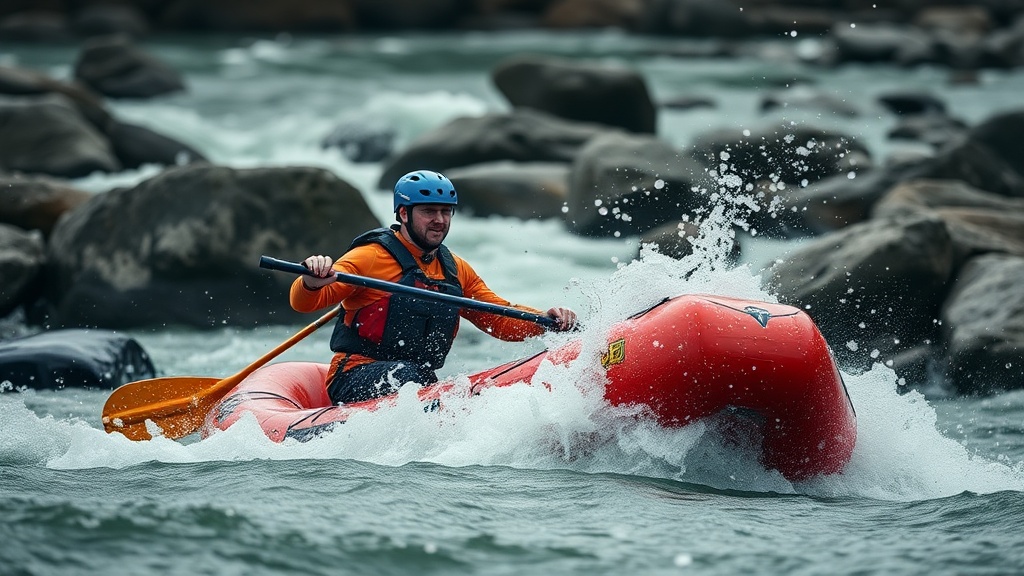
5 key Strength Drills Every Rafter Needs Before Hitting Class IV Rapids

Kettlebell Paddle Rows for Pull Power
Plank Variations for Core Stability on the Water
Box Jumps to Build Explosive Entry Power
Rotational Medicine Ball Throws for Stroke Strength
Interval Rowing for Cardio Endurance
Class IV whitewater demands more than enthusiasm and a decent paddle stroke. The hydraulics, holes, and unexpected swims punish unprepared bodies fast. This post covers five specific strength drills that build the exact power, grip endurance, and core stability you'll need when the river turns serious. Master these movements before your next trip, and you'll stay safer, paddle harder, and recover quicker when the raft decides to buck.
Kettlebell Turkish Get-Ups
This old-school lift isn't flashy. It's slow, deliberate, and brutally effective at teaching your body to move as one solid unit under load. On the river, that translates to smoothly transitioning from a seated position to standing in a bouncing raft without relying on someone else's shoulder.
Start light — a 12 kg or 16 kg kettlebell from Kettlebell Kings works for most beginners. Lie on your back, press the weight overhead with one arm, and stand up without letting that arm drift forward or collapse. The movement builds shoulder stability, hip mobility, and the kind of full-body coordination that keeps you upright when the raft hits a lateral wave. Do 3 sets of 2 reps per side, moving with control rather than rushing. The catch? Speed doesn't impress the river. Stability does. (If you're wobbling, drop the weight and own the technique first.)
Trap Bar Deadlifts
Raw pulling power matters when you're hauling a 200-pound raft up a rocky portage or helping a swimmer back into the boat. The trap bar deadlift is the safest, most efficient way to build that strength without beating up your lower back.
Load a Rogue Fitness trap bar with moderate weight, stand inside the handles, and drive through the floor. Keep your chest up and your grip tight. This drill targets the posterior chain — glutes, hamstrings, and lower back — plus the grip you'll need to hold onto a T-grip paddle for hours. Here's the thing: paddling itself isn't enough. The stroke is repetitive and low-load. You need heavy compound lifts to build real reserve strength. Work up to 3 sets of 5 reps at a challenging but clean weight. Rest 2 to 3 minutes between sets so every rep looks sharp.
TRX Inverted Rows
Paddling is mostly pulling. If your back can't handle sustained horizontal pulling, your form collapses halfway down a long rapid. TRX inverted rows develop the lats, rhomboids, and rear delts while forcing your core to stay engaged — exactly the posture you need in a raft.
Set the TRX Suspension Trainer to chest height, walk your feet forward, and pull your chest to the handles. The closer your feet are to the anchor point, the harder it gets. Aim for 3 sets of 8 to 12 reps. Worth noting: this isn't a substitute for paddling practice, but it builds the muscular endurance that keeps your strokes powerful when you're deep into a run on the Ottawa River. Slow down the eccentric — lower yourself over 3 seconds — and you'll feel the difference after your first long day on the water.
Loaded Carries
Grip strength and core bracing separate competent rafters from the ones who lose paddles and swim. Loaded carries are simple — pick up something heavy and walk — but they deliver exactly those qualities in spades.
Grab a pair of 50-pound Rogue Farmer Walk Handles, or just use heavy dumbbells if that's what your gym has. Stand tall, shoulders back, and walk 40 meters. Your forearms will burn. Your core will shake. That's the point. In a raft, you're constantly gripping, bracing, and adjusting to shifting water. Farmer's carries build the static strength that keeps you connected to the boat. Try 3 rounds of 40 meters, resting as needed between sets. For an extra challenge, wrap Fat Gripz around the handles — your forearms will thank you later (well, they'll hate you now, but they'll perform better on the river).
Medicine Ball Rotational Slams
Whitewater isn't about moving straight up and down. It's about rotating through the torso to generate paddle power from the hips. Medicine ball rotational slams train that exact pattern — explosive rotation through a stable base — without the complexity of Olympic lifts.
Use a 10-pound or 14-pound slam ball. Stand sideways to a sturdy wall, rotate through the hips, and throw the ball into the wall with force. Catch it and repeat. Do 3 sets of 6 per side. The movement mirrors the high-brace stroke and the defensive swimming position you'll use if you go for an unexpected swim. That said, start slow. Rotational power builds over months, not days. If your lower back feels anything other than work, check your form — the power should come from the hips, not from wrenching your spine.
What muscles do you need for whitewater rafting?
You need strong lats, rhomboids, grip muscles, rotator cuffs, glutes, hamstrings, and deep core stabilizers. The lats and rhomboids power every paddle stroke while the grip muscles keep you connected to the paddle and raft lines. The posterior chain — glutes and hamstrings — anchors your body when the raft drops into a hole or surfs a wave. Meanwhile, the rotator cuffs and deep core muscles protect your shoulders and spine from the chaotic, multi-directional forces that Class IV water throws at you.
Upper-body strength gets all the attention, but the real work happens when your legs and hips brace against the tubes while your torso rotates through a stroke. Neglect the lower half, and you'll fatigue faster — plus you'll be more likely to get thrown when the raft hits a big hit. A balanced program hits everything from your fingers to your feet.
How long should you train before tackling Class IV rapids?
Most recreational rafters need at least 8 to 12 weeks of consistent strength training before Class IV rapids feel manageable rather than terrifying. That timeline assumes you're training 3 days per week with a mix of compound lifts, carries, and some aerobic base work like rowing or cycling.
Here's the thing: you can't rush tissue adaptation. Tendons and connective tissue strengthen slower than muscles, and those are exactly the structures that keep your shoulders and elbows intact during a long day on the water. If you're starting from a low fitness base, give yourself 16 weeks. A solid preseason program pays off when you're paddling the Gauley River in West Virginia and your body still has reserves at the take-out. Rafters who show up underprepared don't just perform poorly — they increase the risk for everyone in the boat.
What strength equipment actually helps on the river?
Kettlebells, a trap bar, a TRX Suspension Trainer, Fat Gripz, and slam balls are the pieces of gear that translate most directly to better performance in a raft. You don't need a fancy gym, but the right tools make training more effective and more enjoyable.
| Equipment | Primary Benefit | Best For |
|---|---|---|
| Kettlebells | Shoulder stability and get-up strength | Home gyms |
| Trap Bar | Posterior chain power without spinal load | Commercial gyms |
| TRX Suspension Trainer | Horizontal pulling endurance | Travel and home use |
| Fat Gripz | Forearm and grip strength | Adding to dumbbells or bars |
| Slam Balls | Rotational power and core bracing | Home or gym |
The TRX Suspension Trainer is especially useful for river runners because it packs into a bag and sets up anywhere — hotel rooms, campgrounds, even rigged to a tree at the put-in. Fat Gripz (the blue rubber sleeves that slide over barbell and dumbbell handles) are another underrated tool. They force your forearms to work harder during rows and carries, which pays off when you're gripping a paddle through a long rapid. For kettlebells, the ACE Exercise Library has solid coaching cues on overhead stability that apply directly to the get-up.
Can you get rafting-fit without a gym membership?
Yes, you can build most of the strength you need for Class IV rafting with bodyweight movements, sandbags, and a single kettlebell. Pull-ups on a park bar, inverted rows under a sturdy picnic table, and loaded carries with water jugs all develop the pulling and grip endurance that matter on the river.
The real limitation isn't equipment — it's consistency. You can train in your garage, a local park, or a hotel room between trips. That said, having access to a trap bar or heavy dumbbells makes loading the posterior chain easier, which speeds up strength gains. If you're serious about multi-day trips on big water like the Colorado River through the Grand Canyon, a basic gym membership is worth the investment. But for weekend warriors heading to local runs, a $50 kettlebell and a pull-up bar will get you surprisingly far.
Start with the Turkish get-up and the loaded carry. Add the trap bar deadlift and TRX rows once you've built some baseline strength. Finish each week with rotational slams to develop power that actually transfers to the paddle. Train consistently, respect the timeline, and show up to the river with a body that's ready to work. The rapids won't wait for you to catch up.