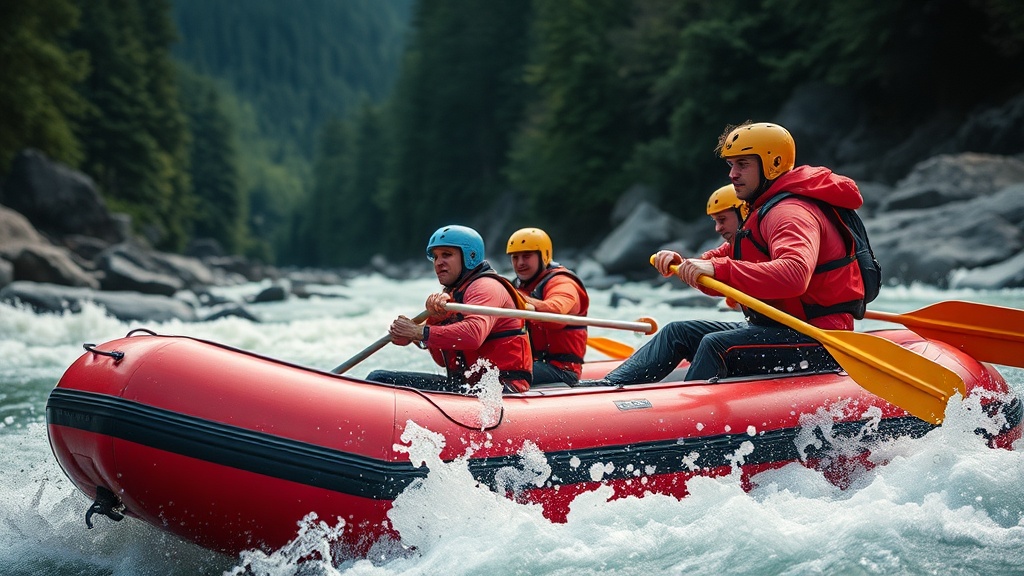
5 Essential Training Tips for Whitewater Rafting Adventures

Build Core Strength for Balance and Control
Develop Upper Body Endurance for Paddling Power
Master Swimming and Water Safety Skills
Train Cardio for High-Intensity Bursts
Practice Team Coordination and Communication
This post covers five proven training strategies that prepare the body and mind for whitewater rafting's physical demands. Whether you're booking a guided trip down the Grand Canyon or planning a self-supported expedition on the Gauley River, proper conditioning makes the difference between an exhilarating adventure and a miserable struggle against the current.
What Muscles Should You Train for Whitewater Rafting?
The primary muscle groups involved in rafting include the latissimus dorsi, shoulders, biceps, and core. Your back and arms handle the paddle work while your core keeps you stable in an unstable boat.
Whitewater rafting isn't just about arm strength — though that's part of it. The repetitive motion of paddling engages the entire posterior chain. Each stroke recruits the lats, rhomboids, and rear deltoids to pull the paddle through the water. The forward reach activates the serratus anterior and lower traps. It's a full-body movement masked as an arm exercise.
The core works overtime in a raft. Unlike a kayak where you're seated with hip contact, rafts demand constant micro-adjustments. You brace against the tubes, shift weight for balance, and stabilize when waves hit sideways. A weak core means soreness, poor technique, and increased injury risk.
Here's a breakdown of muscle engagement by activity:
| Activity | Primary Muscles | Secondary Muscles |
|---|---|---|
| Forward paddling | Lats, biceps, rear delts | Core, quads (for bracing) |
| Back paddling | Triceps, front delts, upper back | Lower back, hamstrings |
| High-siding | Quads, glutes, hip flexors | Core, calves |
| Swim recovery | Full upper body, cardiovascular system | Core, mental fortitude |
The catch? Most gym workouts don't mimic the specific demands of paddling. You'll need targeted exercises that build endurance in these patterns — not just maximum strength.
How Long Should You Train Before a Rafting Trip?
Most beginners should start training 6-8 weeks before their trip for noticeable improvement. Experienced rafters heading for Class IV or V water should maintain year-round conditioning with a 4-week intensification before departure.
Six weeks allows enough time for neuromuscular adaptation and modest cardiovascular gains. You won't become an athlete in two months, but you'll build the baseline fitness that prevents injury and lets you enjoy the experience. The body needs time to adapt to new movement patterns — rushing this process invites tendonitis and muscle strains.
For a typical guided day trip on Class II-III water, two to three weeks of basic conditioning suffices. But here's the thing: those trips aren't the ones that test you. The multi-day expeditions, the high-water spring runs, the technical creeks — these demand respect and preparation.
Worth noting: fitness decay happens fast. A month of hard training followed by two weeks on the couch won't carry you through a five-day Grand Canyon trip. Consistency beats intensity every time.
What Are the Best Exercises for Rafting Preparation?
The most effective exercises combine pulling movements, rotational core work, and interval cardio. Think rows, kettlebell chops, and high-intensity cycling — not bicep curls and steady-state jogging.
1. Pulling Power
Paddling is pulling. Every stroke draws water past the boat, propelling you forward or steering through waves. Your training should reflect this.
Seated cable rows mimic the paddling motion closely. Set the cable at chest height, brace the feet, and pull with a neutral grip. Focus on squeezing the shoulder blades together at the end range — this builds the upper back endurance that prevents shoulder fatigue on long flatwater sections.
Pull-ups (or assisted variations) develop lat strength efficiently. Can't do full pull-ups? Use a resistance band or the assisted machine. Aim for sets of 8-12 reps with controlled tempo. The goal isn't maximum weight — it's volume tolerance.
Resistance band paddling drills add sport-specific conditioning. Anchor a heavy band at shoulder height, stand in athletic stance, and simulate paddling strokes. Perform 30-second intervals, alternating sides. This builds the muscular endurance that keeps your technique sharp when you're exhausted.
2. Core Stability Under Load
A strong core in rafting isn't about crunches. It's about resisting rotation and maintaining posture while forces try to knock you off balance.
Pallof presses train anti-rotation strength. Stand perpendicular to a cable machine, hold the handle at chest height, and press straight forward without letting the weight pull you sideways. Hold the extended position for two seconds. This mimics bracing against current while reaching for a paddle stroke.
Turkish get-ups build full-body stability and shoulder endurance. The movement demands controlled rotation, hip mobility, and the ability to stand from the ground with weight overhead — surprisingly similar to recovering from a swim in moving water.
Plank variations with shoulder taps or weight shifts develop the dynamic stability that keeps you upright in technical rapids. Hold standard planks for 45-60 seconds, then progress to movement variations.
3. Cardiovascular Conditioning
Rafting taxes the aerobic system differently than running. Bursts of high-intensity paddling alternate with lower-effort drifting. Your training should match this pattern.
Rowing machines offer the closest approximation to paddling. The Concept2 Model D remains the gold standard for good reason — the flywheel resistance mimics water's variable load. Program interval workouts: 30 seconds hard, 30 seconds easy, repeated for 20 minutes.
Cycling (stationary or outdoor) builds quad endurance for bracing without the joint impact of running. High-intensity interval training on a bike translates well to the energy demands of big water.
Swimming provides full-body conditioning with obvious relevance to the sport. If you end up in the river, swimming fitness becomes survival fitness. The freestyle stroke shares mechanical similarities with paddling — rotation, reach, catch, pull.
What Gear Helps With Rafting Fitness Training?
Quality equipment removes barriers to consistent training. You don't need much, but the right tools make preparation more effective and sustainable.
For home training, a set of resistance bands (the Rogue Monster Bands offer excellent durability) replaces expensive cable machines. Loop bands work for lower-body activation. A suspension trainer like the TRX Home2 System enables rowing, plank variations, and rotational exercises anywhere you can anchor it.
Kettlebells between 16-24kg cover most training needs. They're compact, versatile, and the offset load challenges stability in ways that barbells can't replicate. Swings build posterior chain power. Goblet squats develop leg strength for bracing. Turkish get-ups cover everything else.
A heart rate monitor helps gauge training intensity. The Polar H10 chest strap provides reliable data for interval workouts. Smartwatches work too, though wrist-based heart rate lags during rapid intensity changes.
Don't overlook recovery tools. A foam roller (the TriggerPoint Grid pattern works well) addresses the muscle tightness that develops from repetitive paddling motions. Lacrosse balls target the upper back and shoulders.
How Do You Prepare Mentally for Whitewater Rafting?
Mental preparation involves visualization, breathing practice, and exposure to controlled discomfort. The mind quits before the body does — training it prevents panic in critical moments.
Visualization works. Spend five minutes before bed mentally rehearsing scenarios: flipping in a rapid, swimming to an eddy, recovering a swimmer. Picture the sensations — cold water, the roar of hydraulics, the effort of swimming. This pre-exposure reduces anxiety when reality matches imagination.
Breath control matters in whitewater. When you hit cold water, the gasp reflex can cause panic. Practice box breathing (four counts in, hold, out, hold) during workouts. Learn to exhale underwater in the pool. These skills transfer directly to swim scenarios.
Cold exposure training — cold showers, ice baths, winter swimming — builds psychological resilience. It's not about becoming Wim Hof; it's about reducing the shock response when you inevitably get wet. Start with 30 seconds of cold at the end of your shower. Gradually extend.
That said, nothing replaces actual river time. Pool sessions with a local kayak club, swiftwater rescue courses, even playing in small rapids on an inflatable — these experiences build the judgment and comfort that no gym workout can provide.
Sample Training Week
Here's how a typical preparation week might look for someone targeting a Class III-IV trip in six weeks:
| Day | Training Focus | Duration |
|---|---|---|
| Monday | Pulling strength + core | 45 minutes |
| Tuesday | Rowing intervals (HIIT) | 30 minutes |
| Wednesday | Active recovery (yoga, light swim) | 30-45 minutes |
| Thursday | Full-body conditioning (kettlebell circuits) | 40 minutes |
| Friday | Longer steady-state cardio (cycling or hiking) | 60 minutes |
| Saturday | Swim practice + technique drills | 45 minutes |
| Sunday | Rest or gentle movement | — |
Adjust based on your starting fitness and trip difficulty. The key is progressive overload — gradually increasing volume or intensity each week — followed by a taper in the final few days before your trip.
"River running isn't about being the strongest person in the boat. It's about being the most prepared to keep going when conditions get hard." — Traditional river guide wisdom
Physical preparation for whitewater rafting pays dividends beyond safety. A well-conditioned body lets you focus on the experience — the canyon walls drifting past, the camaraderie of the crew, the pure rush of threading a clean line through chaos. The river doesn't care about your training, but you'll care a lot more about the river when your body has the capacity to meet its demands.