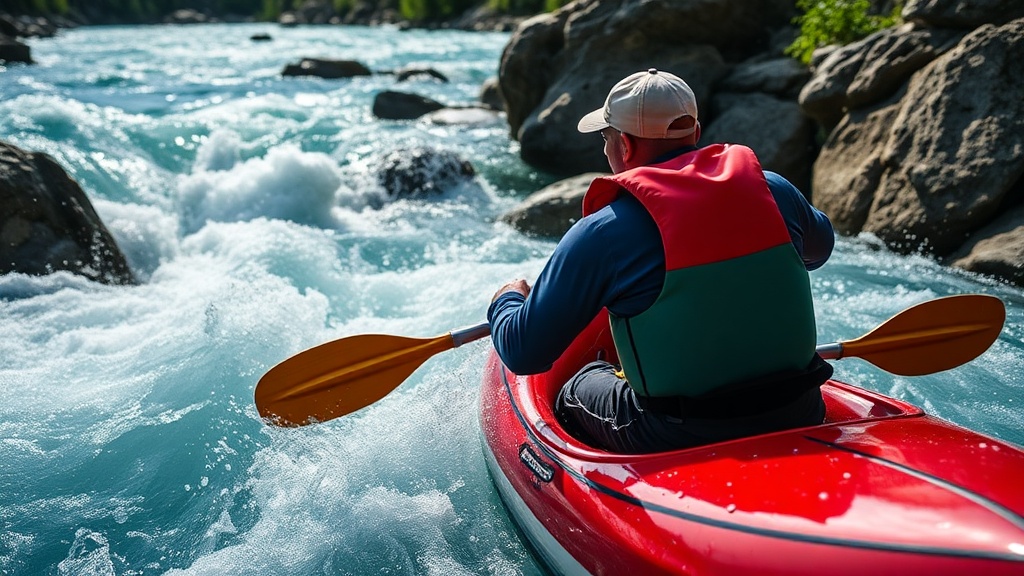
5 Essential Exercises to Build Paddle Power for Whitewater Rafting

Resistance Band Paddle Pulls
Kettlebell Turkish Get-Ups
Plank with Shoulder Taps
Medicine Ball Rotational Throws
Farmer's Carries with Fat Grips
What This Post Covers (and Why Paddle Power Matters)
Whitewater rafting demands more than enthusiasm and a life jacket. The rapids don't care about good intentions. Without serious paddle power, you're just along for the ride — and not in a good way. This post breaks down five targeted exercises that build the specific strength, endurance, and explosive power needed to control a raft through Class III and IV rapids. Whether you're planning your first trip down the Ottawa River or gearing up for guide training, these movements will transform how you handle the paddle.
What Muscles Do You Use Most When Whitewater Rafting?
You rely heavily on your lats, shoulders, and core — but here's the thing: rafting is a full-body effort that starts in your legs and transfers through your torso. The paddling motion itself demands strong lats and rear deltoids for the pull, but the real power comes from rotational core strength and a stable lower body that anchors each stroke.
Many beginners make the mistake of thinking rafting is all "arm work." That's a fast track to fatigue — and possibly swimming. Your arms are just the connection point. The engine is your back, your obliques, and your hips working together. Train accordingly.
Exercise 1: Kettlebell Swings for Hip Drive
The kettlebell swing builds exactly the kind of explosive hip hinge that drives powerful paddle strokes. It's not a squat. It's not an arm raise. It's a ballistic hip extension that teaches your posterior chain to fire hard and fast — the same pattern you use when bracing against a rapid or pulling hard to catch an eddy.
How to do it: Start with a 16kg kettlebell (men) or 12kg (women) if you're new to the movement. Hinge at the hips, keep your back flat, and snap your hips forward to drive the bell up. The arms are just along for the ride — the power comes from your glutes and hamstrings.
Do 4 sets of 20 swings, resting 90 seconds between sets. The catch? Form breaks down fast when you're tired. Stop before your lower back starts to arch. Rogue Fitness makes excellent kettlebells — the Rogue Kettlebells have a smooth finish and consistent handle width that won't tear up your hands.
Exercise 2: Pull-Ups (Weighted If Possible)
Pull-ups build raw pulling power that translates directly to paddle control. Every stroke in whitewater rafting involves pulling water — and sometimes pulling yourself back into the raft after an unexpected swim. If you can't do a pull-up, you can't fully control a paddle in heavy water. Full stop.
Progression: Start with assisted pull-ups using a band or machine. Work toward 3 sets of 8-10 clean reps. Once you hit that, add weight with a dip belt. The Rogue Dip Belt is worth the investment — it doesn't dig into your hips like cheaper alternatives.
Vary your grip. Wide grip hits your lats harder. Neutral grip (palms facing) is easier on the shoulders and builds practical strength for paddling. Mix them. The goal isn't just more reps — it's stronger reps with full range of motion.
Exercise 3: Turkish Get-Ups
This odd-looking movement builds something most gym exercises miss: the ability to stabilize weight overhead while moving through multiple planes. On the river, you're rarely in a stable position. The raft tilts. Waves hit you from the side. You need core strength that works when everything is shifting beneath you.
The Turkish get-up delivers that — and shoulder stability that prevents the overuse injuries common among guides who paddle 100+ days per season.
The movement: Lie on your back holding a kettlebell overhead. Roll to your elbow, then to your hand, lift your hips, sweep your leg under, and stand up — all while keeping that bell stable above you. Reverse the motion. It's slow, deliberate, and brutally effective.
Start light — really light. A 12kg bell is plenty for most people learning the pattern. Do 3 sets of 3 reps per side. Quality over quantity. This isn't cardio; it's motor control and anti-rotation core work disguised as a strength movement.
Exercise 4: Medicine Ball Rotational Slams
Rafting is rotational. Every paddle stroke involves twisting through your torso to generate force. The medicine ball rotational slam trains that exact pattern — explosive rotation, power transfer, and core engagement — while conditioning your body to generate force from the ground up.
Execution: Stand sideways to a wall (or just slam into the floor), hold a medicine ball at hip height, rotate your torso away from the target, then explode through your hips and slam the ball. Catch it on the bounce (or pick it up) and repeat.
Use a ball that bounces — the Rogue Medicine Balls hold up well to repeated abuse. A 10-14 pound ball works for most people. Do 3 sets of 10 slams per side, moving as fast as possible while maintaining control.
Worth noting: this movement should feel athletic, not like a chore. If you're moving slowly, the weight is too heavy. Speed matters more than the number on the ball.
Exercise 5: Farmer's Carries
Grip endurance. Postural stability. Core bracing. Loaded carries build all three — and they're painfully simple. You pick up heavy things and walk. That's it. But that simplicity masks serious benefits for rafters who need to hold a paddle for hours while maintaining proper posture.
Weak grips fail first on long rapids. When your hands open up, you lose the paddle. When you lose the paddle, you're useless to your team. Farmer's carries prevent that.
Protocol: Grab two heavy dumbbells or kettlebells — roughly half your bodyweight total is a good starting point. Stand tall, brace your core like someone's about to punch you, and walk 40-50 meters. Turn around and come back. That's one set. Do 4 sets, resting 2 minutes between.
The weights should feel heavy by the end of each carry. If you could walk further, go heavier. Rogue's hex dumbbells work well, but kettlebells are easier to grip for longer distances.
How Often Should You Train for Rafting Season?
Two to three sessions per week is the sweet spot for most people. More than that and you risk overtraining — especially if you're already active. Less than that and the adaptations come too slowly to matter.
Structure your week around quality, not quantity. A sample schedule:
| Day | Focus | Key Movements |
|---|---|---|
| Monday | Power & Pulling | Kettlebell swings, weighted pull-ups, rotational slams |
| Wednesday | Stability & Control | Turkish get-ups, farmer's carries, core work |
| Saturday | Full Integration | All five exercises at moderate intensity |
Start this program 8-12 weeks before your first big trip. Strength adaptations take time — neural improvements happen in weeks, but tissue remodeling needs months. That said, even four weeks of consistent training beats showing up cold.
What Gear Do You Actually Need?
You don't need a gym membership. A single kettlebell, a pull-up bar, and a medicine ball cover most of these movements. Total investment: under $300 if you buy quality equipment that lasts.
For home setups, consider the Rogue P-4 Pull-Up System — it mounts to a wall and doesn't wobble like doorway bars. For kettlebells, buy one medium weight (16-20kg for most men, 12-16kg for most women) and learn the movements before expanding your collection.
If you prefer training at a gym, any facility with free weights and open floor space works. Avoid machines — they isolate muscles and teach your body to work in fixed planes. The river doesn't offer fixed planes.
Programming for Different Skill Levels
Beginners should focus on movement quality above all else. Master the hip hinge for swings. Learn to brace your core properly for carries. Do pull-ups with assistance rather than struggling through ugly reps. Bad form engrains bad patterns — and on the river, bad patterns lead to injury.
Intermediate paddlers can add intensity. Weight the pull-ups. Use heavier kettlebells. Reduce rest periods slightly. The goal shifts from learning to adapting — forcing your body to build capacity through progressive overload.
Advanced rafters and guides need periodization. Build a base in the off-season, add power work as the season approaches, and maintain (don't build) during the guiding season itself. Recovery matters more than extra sessions when you're paddling 5+ days per week.
Common Mistakes to Avoid
Don't skip the Turkish get-ups because they look weird. Don't replace farmer's carries with more bicep curls. Don't treat kettlebell swings like squats — the knees barely bend.
Another trap: training only the "mirror muscles." Chest presses and bicep curls won't help on the river. Your back, your rotator cuff, your obliques — that's where the money is. Train what you can't see in the mirror.
Finally, don't neglect conditioning. These strength exercises build power, but rafting also requires aerobic capacity for long days on the water. Add one or two sessions of rowing, swimming, or paddling a kayak to build sport-specific endurance. The best strength in the world won't help if you're gasping for breath halfway through the rapid.
Start now. The river waits for no one — and it respects strength.